Showing posts with label Express Yourself Workshops. Show all posts

Friday, July 5, 2013

Getting ready...

Finally preparing brochures for our workshop: Rhythm in the city

...Getting ready for BCN. See you soon

Tuesday, June 4, 2013

Have Fun Expressing Yourself

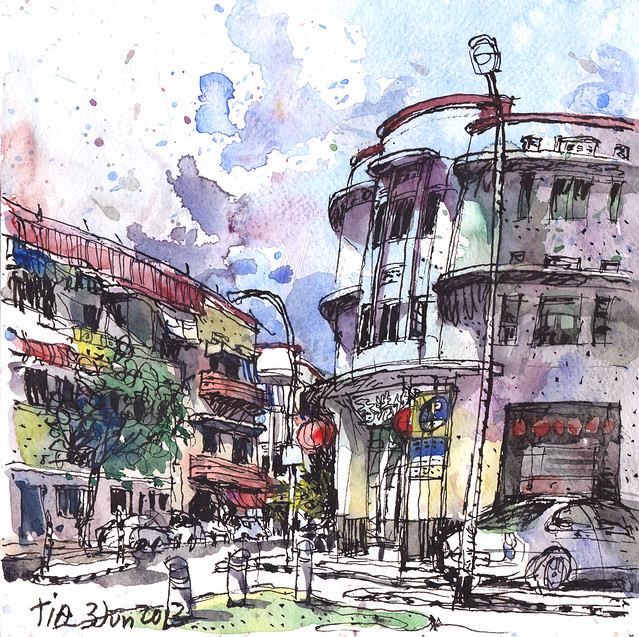
130603_TiongBahru Hello all, I can't wait to meet all of you in Barcelona! So excited!
Paul and I will be conducting a workshop together under the category of "Express Yourself".
We hope participants in our workshop will achieve the following objectives:

•To explore ways of creating a strong focal point in our sketches.
•To experiment with alternative drawing tools and mediums during the sketching process.
•To create a bold & fluid exchange between sketching, mark-making and painting.

The key words are "focal point", "experimentation" and "mark-marking" which I did in my sketch posted here. I have been sketching the same view a few times and no two sketches are the same in terms of these three key words. At the end, it is to enjoy, have fun and express myself!

Size : 250mm x 250mm
Medium : ink and watercolour
Technique : splashing, blind contour, scribbling.

Monday, May 6, 2013

Sketching at SHOTS CAFE (Club Street), Singapore

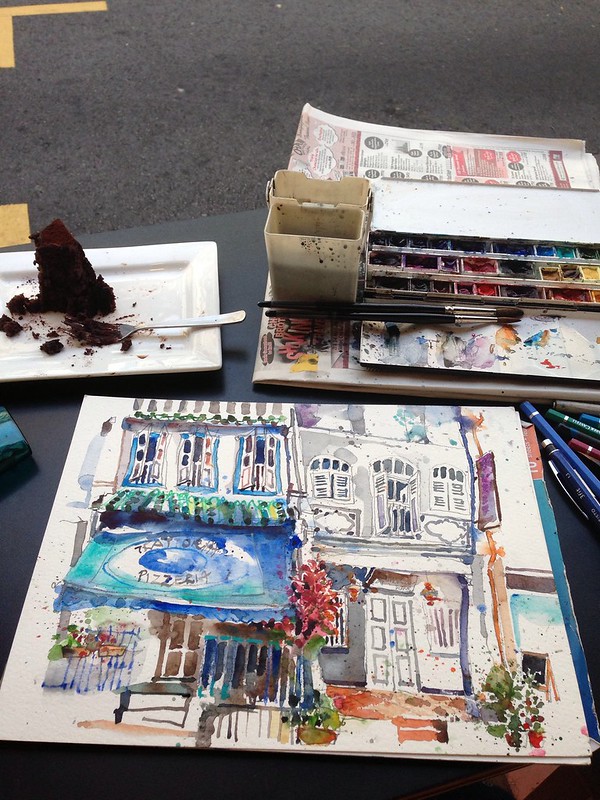
Warming greetings from Singapore. The weather here is erratic. Hot scorching day can suddenly turn grey and very wet! I am very excited to visit Barcelona again and share my sketching journey with fellow symposium participants. Back at SHOTS Cafe @Club Street
I drew this on-location last Saturday when the sun was going down. As you can see, my chocolate fudge cake was half eaten and I had to finish as much as I can before the light runs out. Before beginning any sketch or painting, it is important to lay out all my tools and know their location. Then I sit and observe carefully the scene in front of me. What is the story today (Conflict or Love)? Where is the focal point? And then the symphony begins......  Below is a recent picture of me sharing my sketches with a few thai boys in Bangkok. I had to try some sign language as I don't speak any thai.

Friday, March 8, 2013

Capturing Space Through Form and Color (Workshop T)


Instructor: Marion Rivolier (Paris)
Location: Palau de Mar

This workshop will focus on space and color. After a quick analysis of the building or place, we will explore ways to create volume and space using watercolors and painting "directly" — no preliminary sketching in pencil or pen. We will work with brushes throughout the workshop, and stick to a limited palette, mixing our colors (green, ochre, red, blue, yellow etc.) without using black. Our aim will be to capture the essence of the place as quickly as possible.

Relying on color is a sensitive approach that works through experiment. How do certain colors vibrate when placed next to one another? What is it that makes these vibrations and relationships create volume and space?

The three-hour workshop will be divided into 3 parts:

A- For the first 30 minutes we will sketch the space as quickly as possible, working with masses and focusing on the contrast of light and dark. What are the colors that make up the shadows and lights? These sketches will help us to understand the space we are in and to see beyond "black and white." Special attention will be made to reserving areas of the page, using the white of the paper as well to position light and contribute to the composition of the space.

B- For the next 45 minutes we will work with color contrasts, exploring different means for conveying a feeling of the space using ranges of colors and playing with temperature (warm/cool). Setting aside the lights and darks for a while, we will work on freeing ourselves up to feel the richness and variety of the colors we see (for example, grass is not green but a lot of colors: brown, blue, yellow, ochre etc.)

C- After the quick sketches described above, the remaining 1 hour and 45 minutes will be spent on longer sketches using the two forms of contrast weÕve explored earlier: light and color. By working from dense masses to lighter ones, foregrounds, middle-grounds and backgrounds can be created. If we try to keep our colors luminous and intense, weÕll see how they can do the work for us of creating volume and space. Later on, lines can be added little by little where needed (using only a brush). These lines will also be inÉ color!

Learning goals
  • to perceive a complex place and describe it through colored masses.
  • to step outside of the "coloring book" approach of drawing and filling in lines, and to gain confidence in painting directly.
  • to feel free with colors and able to interpret reality.
  • to free the hand and let it draw "without the mind". To practice focusing on the subject with less thought on the actual drawing (letting go of the idea of creating a "pretty picture"). To discover how this freedom can allow the feeling of a space to come through.

Supply list
  • Watercolor sketchbook (Bring two if possible to save waiting for things to dry. A4 (8 1/2" x 11") or larger are recommended for beginners.)
  • Watercolors: limited palette (primary yellow, Naples yellow, orange, vermilion, cadmium red, cerulean blue, cobalt blue or ultramarine, Prussian blue, green, ochre, no black)
  • Three paintbrushes (small, medium and large)

Other sample sketches


Monday, March 4, 2013

Drawing from the Heart and over Color Splashes (Workshop P)


Instructors: Paul Wang and Tia Boon Sim
Location: Palau de la Música Catalana

We often see students and fellow sketchers scratching their head and wondering how they became lost in the sketching jungle. After asking a probing question, “What is the story you are trying to tell?”, these sketching warriors quickly reveal that they have no road maps, no plot and no strong cohesive story to tell.

A strong, cohesive story needs a clear focal point (eg. An interesting door way or window), something that grabs your attention. Then from the heart of the sketch we can creatively develop our story.

Objectives
  • To explore ways of creating a strong focal point in our sketches.
  • To experiment with alternative drawing tools and mediums during the sketching process.
  • To create a bold & fluid exchange between sketching, mark-making and painting.


FOCAL POINT & PATHWAYS OF SKETCHING

Participants to try this 3 simple exercise before sketching on newspaper. These are roadmaps to help stay on course.
  1. SPIRAL – Concentric drawing approach, creating connection to the focal point.
  2. STAR BURST – Radiating lines/shapes from focal point, Magic triangle, asymmetry.
  3. CROSSWORD PUZZLE – Intersections, Horizontals & Verticals, cruciform, fulcrum, tension.

Participants to focus on observing the environment and identifying a strong focal point (Crux of the story).

Participants can use any of the 3 suggested pathways of sketching to develop their sketch, always referencing to the focal point. Some may even combine 2 methods to create new permutations.

EXPERIMENTATION WITH SKETCHING AND PAINTING MATERIALS
  • Participants will try to develop the sketch from the focal point using alternative tools and water-soluble mediums. Splashing, mixing colours on paper, scratching/scraping, wax-resist are some ways to create interesting marks.
  • Participants will be encouraged to sketch and experiment with twigs, bamboo pens, different inks and any other water-soluble mediums, sandpaper, crayons during the sketching process.
  • Participants will also be encouraged to work back and forth between sketching and painting in a very bold and fluid manner.

Learning goals
  • Participants will learn to see things from complexity to simplicity, see objects as shapes, playing with colour splashes freely.
  • Participants will learn simple line and shape sketching, explore colour splashes to paper, and experiment with texture manipulation through the use of salt, coffee, candles and crayons.
  • The workshop will also help participants appreciate the unexpected outcomes in art and learn to have fun with the process of exploring various expressions through sketching and colouring techniques.

Supply list

Watercolour, water-soluble pencils/coloured pencils, drawing ink, bamboo pen, pens, salt, crayons, loose sheets of paper.

Other sample sketches


Tuesday, February 26, 2013

Sketches that Sing: Creating Sketches with a Life of their Own (Workshop L)


Instructor: Lynne Chapman (Sheffield, UK)
Location: Plaça Vicenç Martorell

In the battle to interpret accurately what is in front of us, it is easy to forget that a successful sketch needs also to sing and dance with an energy of its own. No matter which subject matter we are tackling, our best sketches have this inner vibrancy: an independent strength, which might come from a particular use of colour, from mark-making, from tonal contrasts, or from all manner of visual surprises which can sometimes be as much about how we frame or crop our subject, or what we choose not to draw, as much as what we actually put on the page.


The Practical

The time will be divided into a series of shorter tasks, looking at different ways of challenging ourselves to gently manipulate realism for dramatic effect. We will aim to capture the sense of place, or the essence of the subject, but at the same time, we will use various different techniques to free up our sketches, focusing attention on the dynamism of the page.

Elements with which we will experiment:

Colour: exaggerated or non naturalistic colour; a limited palette; harmonious versus contrasting colours.
Mark-making: pattern and decorative marks; directional contrast; busy marks versus calm; free-floating line.
Composition: very tight cropping; exciting negative space and shadows.

Learning Goals
  • The freedom from the need to be a slave to realism, which can open the sketcher up all kinds of experimentation and make the experience of drawing more playful.
  • An understanding of how a sketch has a life which is entirely independent of its subject matter and how, once the original location is left behind, the sketch is judged without reference to the subject, but on its own terms.
  • The ability to employ varied and exciting mark-making for dynamic effect, and to make choices about the way different media work together to create interesting visual contrast.
  • An awareness of the dramatic potential inherent in negative space, and of techniques which can draw attention to it.
  • An awareness of how the way in which we frame our subject on the page effects the finished sketch, and how we can use the edges of the page, or employ drastic cropping, to add emphasis.
  • An understanding of the possibilities for using colour or tone to draw the eye, through enhanced contrast or harmonies.
  • The ability to free up a sketch through the simplification of colour and an understanding of how working with a limited palette can enforce new and unexpected choices when we are depicting what is in front of us.

Supply list

A selection of media will help you get the most use from the workshop.
  • Make sure your kit includes coloured drawing or painting materials.
  • Something which makes a powerful mark would be helpful eg conte, soft graphite stick, bamboo pen etc
  • NB if using pastels, conte or graphite sticks, a small pack of Wet-Ones and a small hairspray, to use as fixative, are very handy!

Sample sketches


Tuesday, February 12, 2013

Rhythm in the City (Workshop B)


Rhythm in the city. by Inma Serrano. from Urban Sketchers on Vimeo.

Instructor: Inma Serrano (Sevilla)
Location: Plaça del Pi

The city develops around us as something alive and human, as something awake and constantly moving. If we want to speak about the moment we are living we have to show in our sketches what is inside it: The rhythm that moves the city.

We will base the workshop in three main areas:
  • People are alive. The rhythm of people.
  • Buildings are alive. The rhythm of the buildings.
  • Color is alive. The rhythm of color.

PEOPLE ARE ALIVE

This first exercise will specially attempt to offer some keys to synthesize the human figure and reduce it to simple and organic gestures and forms.

We can use similar abstract shapes to draw quickly similar elements like heads, clothes or bags that at the end conform a person…

The rhythm of people.

The object of this exercise will be to find out which is our personal way to draw quickly these forms that allow us to work easily with our memory once people change positions.

Also we will look for those quickly ways to draw things far away, those simple and abstract shapes that make our brains associate them with figurative forms.

BUILDINGS ARE ALIVE

In the next step, we will look for these same organic forms in a seemingly lifeless object as architecture is.

In applying these forms to architecture, you generate a distortion and a movement that gives it dynamism and life.

The rhythm of the buildings.

COLOR IS ALIVE

Color can be applied in a smooth or violent way, orderly or disorderly, concrete or abstract, real or unreal to compose with it the character we want our sketch to have.

An only spot of color that moves through our paper can be the body of one person. With one quickly stroke we can generate a movement. We can give life.

Finally we will do a color quickly exercise to check how the color can also be the main leitmotif in our sketch. The rhythm of color.

Learning goals
  • To find the personal quick drawing gesture that synthesizes complex and elaborate human forms into simpler and straightforward forms.
  • To play with architecture and buildings losing respect for the straight and rational forms, looking for the gesture and the irrational movement.
  • To find a partner in color and its application, to compose and manage the pace of our sketch.

Supply list

Easy-to-use tools and the desire to have fun sketching.

Sample sketches